
SEO has always been part science, part art. In 2026, AI has made the science side faster: keyword grouping, content gap review, technical audits, and reporting can move sooner when the workflow has good constraints.
Google's AI search optimization guidance treats this work as SEO: make pages crawlable and useful, contribute original expertise, and organize information for readers. Special AI schema, artificial content chunking, and an llms.txt file are not requirements for Google Search. This guide was reviewed against Google's documentation on September 7, 2026.
At ValeoFX, we use AI as a review and planning layer, not as a shortcut around expertise. The workflow below is the shareable version: practical enough to use, but without private client data, prompts, or implementation details.
The useful lesson is the workflow, not a promise that every site will see the same result.
Phase 1: AI-Driven Keyword Research
Traditional keyword research meant hours in Ahrefs or SEMrush, manually filtering thousands of terms. Now:
- Cluster analysis: AI groups related keywords by semantic intent, not just search volume.
- Gap detection: Machine learning identifies keywords your competitors rank for that you don't.
- Trend review: Search demand, competitor movement, Google Trends direction, and Search Console impressions are reviewed together before deciding which pages deserve attention.
The useful pattern is early prioritization. AI can help surface underserved buyer-intent queries sooner, but the lift still comes from sharper pages, better internal links, stronger proof, and careful measurement. For service businesses, this usually means improving the SEO services, technical audit, or highest-impression service page before publishing another generic post.
Phase 2: Content Optimization
AI can assist an editor's review, but suggestions need factual checks and a clear purpose for the reader:
- Semantic enrichment: AI analyzes top-ranking pages and recommends entities, topics, and questions to cover.
- Trust-signal review: Tools can flag missing author, sourcing, proof, readability, heading, and internal-link signals, but they do not create E-E-A-T by themselves.
- Readability optimization: Automated suggestions for sentence structure, heading hierarchy, and internal linking.
The E-E-A-T Framework
Google frames E-E-A-T as part of evaluating helpful, reliable, people-first content. For this site, demonstrate it with named author expertise, visible project evidence, and links to relevant case studies rather than treating it as a tool score:
| Signal | How We Demonstrate It |
|---|---|
| Experience | Lessons from real client projects |
| Expertise | Technical depth backed by shipped implementation work |
| Authority | Selected portfolio and case-study evidence |
| Trust | Clear pricing context and transparent proof |
Phase 3: Technical SEO Automation
Use crawlers, rendered-page inspection, and performance tools to collect evidence. AI can help organize findings, but it cannot substitute for checking the actual page:
- JavaScript rendering checks: Compare the delivered and rendered page, then use Search Console URL Inspection to investigate what Google received.
- Performance validation: Test representative pages and interactions before release, then review real-user Core Web Vitals when available. A prelaunch lab result does not predict every user's CLS or INP.
- Internal linking review: Find important pages without useful links and add contextual links where they help readers navigate.
- Structured data validation: Check markup against visible facts and the requirements for the relevant Google-supported feature. Generating schema alone does not guarantee indexing or rich results.
Phase 4: Programmatic Content at Scale
For e-commerce and directory sites, AI enables programmatic SEO:
- Location or category pages only when each page has real local data, inventory, proof, or first-party observations.
- Product comparison pages that dynamically update based on inventory.
- FAQ generation from real customer support data.
The key: do not publish AI-assisted pages unless they add first-party experience, clear sourcing, and editorial review. Use AI for clustering or drafts, then add the evidence, tradeoffs, client-safe examples, screenshots, and measurements that a generic rewrite cannot provide.
An anonymized example: a service site had impressions on several buyer-intent queries, but the ranking page was too generic. The AI-assisted step was clustering the queries and drafting a page brief. The human work was deciding which service page should own the intent, adding local proof, improving the internal links, and rewriting the CTA around the actual buyer problem. That is the version of AI SEO worth shipping.
What We Measure
For AI-assisted SEO work, the scorecard should stay grounded in observable signals:
- qualified impressions and clicks on priority pages
- pages that moved from discovered or crawled to indexed
- query-to-page match improvements
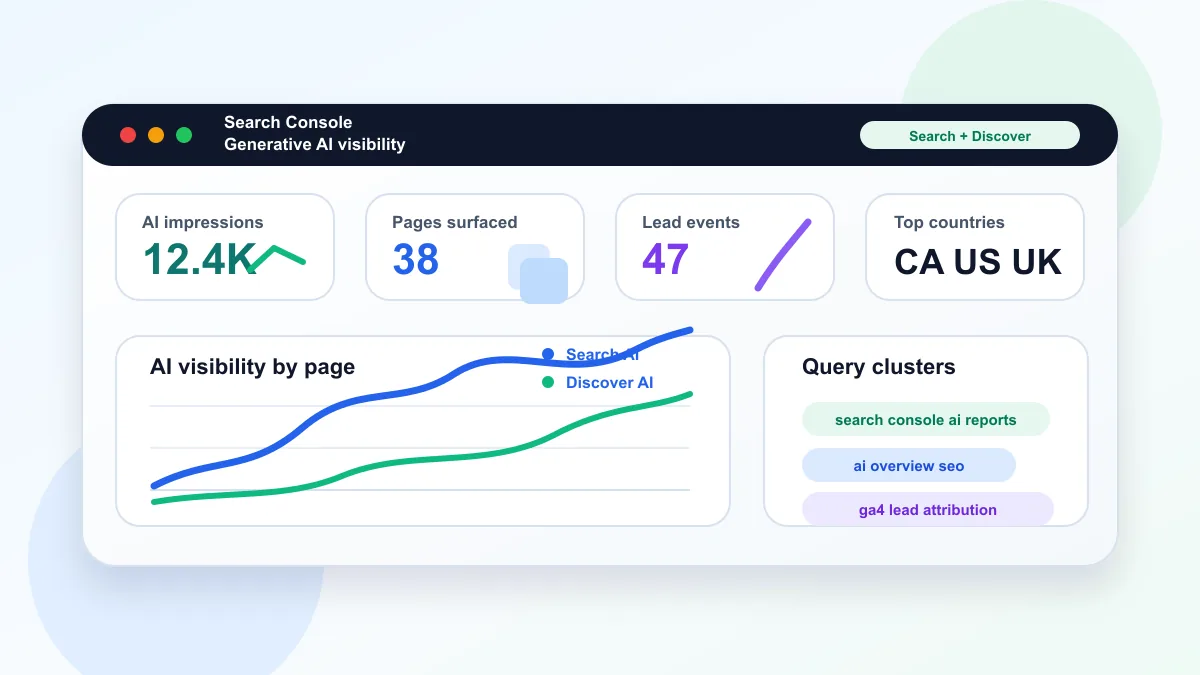
- AI Overviews and AI Mode impressions in Search Console's Generative AI performance report, where the property has enough data
- technical issues found before launch
- internal links added between relevant service, article, and proof pages
- contact, quote, and start-project events from organic traffic
Google's Generative AI performance report documents impressions by page, country, date, and device. It does not attribute individual inquiries to AI answers. Keep those impressions separate from overall search clicks and organic lead events when reporting results.
Also check the property's Search generative AI control. Inclusion is the default, but a property may inherit a parent's setting. Neither an eligible setting nor valid markup guarantees that Google will display a page.
These signals help decide whether the next change should address content, technical access, proof, or conversion. Record what shipped separately from any later movement in traffic or leads.
Getting Started
If you're not using AI in your SEO workflow yet, start here:
- Audit your current rankings with an AI-powered tool.
- Identify your top 10 keyword gaps.
- Create AI-assisted content briefs for each gap.
- Write with authority — your experience is the differentiator AI can't replicate.
SEO is not dying. It is evolving. Teams that combine AI-assisted review with genuine expertise, useful pages, and careful measurement will be better positioned for organic search in 2026 and beyond.
Keep the Thread Going
- Service path: AI SEO Systems
- Technical foundation: Technical SEO Audit Toronto
- SEO implementation: SEO Services Toronto
- Measurement guide: Search Console AI Reports
- Related read: Agentic AI: How Software Teams Use It in 2026
- Related public work: Husn Spa
- Ready to scope your own version? Start a project