
Custom Web Development
Custom Web Development for Toronto Business Websites
Build around the parts of your business a template cannot handle: a service-area structure, a detailed quote flow, a CRM connection, or a publishing workflow. We define those requirements before choosing the frontend, content system, and integrations.
Custom web development means designing the website around your content, customer decisions, and operational requirements instead of adapting the business to a theme. For a Toronto service company, the scope might include service and coverage pages, package comparison, booking access, and a quote flow connected to the team's existing tools. A more complex project may need structured content, API integrations, or different publishing permissions. We use Next.js and React where those requirements justify a custom frontend, and assess an existing WordPress setup before recommending a rebuild. The project starts with a page and integration inventory, named acceptance checks, and a handoff plan for the people who will maintain it. HomeCleaners and Funded by AK below show different service-business interfaces we delivered; their published case studies describe the work without promising a traffic or revenue uplift for your project.
Related case study: HomeCleaners - Built a responsive service experience around local coverage, proof, package discovery, and quote routing.
Timeline
3-10 weeks depending on scope
Investment
Fixed scope or agile sprint retainer
Primary offer
Fixed scope or agile sprint retainer
Problems we diagnose
What the engagement delivers
An agreed page inventory and reusable templates for the actual content
Specified booking, quote, and integration paths with tested success and failure states
A documented publishing workflow, source-code handoff, and post-launch measurement baseline
What we can implement
Your proposal confirms the deliverables, priorities, and launch requirements included in the engagement.
- Discovery covering pages, editors, integrations, current URLs, and launch constraints
- Reusable page templates and a content model aligned to the publishing team
- Responsive Next.js and React implementation with keyboard and mobile checks
- Scoped CRM, booking, API, and automation integrations
- Inquiry validation, accepted-lead events, and integration error-state testing
- Redirect and canonical checks where URLs change, deployment QA, and handoff documentation
Delivery Process
Discovery workshop and technical blueprint
Wireframes and conversion-led UX mapping
Frontend and backend sprint implementation
Performance, accessibility, and SEO QA
Launch, analytics verification, and handoff
Implementation stack
Related work and implementation guides
Next.js, local service UX
HomeCleaners
Built a responsive service experience around local coverage, proof, package discovery, and quote routing.
HomeCleaners custom Next.js case studyNext.js, professional service UX
Funded by AK
Built a trust-led mortgage experience with educational journeys, application access, and consultation paths.
Funded by AK custom Next.js case studyFAQs
When is a custom website worth building instead of using a theme?+
A custom build is useful when a documented requirement cannot be handled cleanly by the existing platform: complex service discovery, structured content, a specific quote workflow, or an integration. If the current WordPress site only needs a focused repair, a simpler improvement may be the better scope. We assess the requirement, content, editing needs, and maintenance responsibility before proposing a stack.
What should we include in a custom web development brief?+
Share the current site, important pages and customer journeys, content owners, required integrations, and any deadline tied to the launch. Include existing search landing pages and URLs that must be preserved. The proposal should identify templates, content migration, integration access, acceptance checks, and responsibilities after launch.
How fast can you launch a custom website?+
Most marketing and lead-generation builds launch in 3-6 weeks. Larger platform builds with advanced integrations typically run 8-10 weeks.
Do we own the code and assets?+
Yes. You own the full codebase, design assets, and deployment access at handoff.
Can you work with our internal team?+
Yes. We can operate as your delivery partner, collaborate with your in-house team, or lead end-to-end execution.
Insights
Relevant insights
Use the articles and tutorials below to deepen the exact implementation thread behind this service.

Zero-Bundle Thinking for Faster Web Experiences
What zero-bundle patterns actually mean, when they help, and how they reduce shipped JavaScript without killing UX in production.

Green Web Development: Building Faster, Leaner Sites
How cleaner architecture, smaller bundles, and lower infrastructure waste can improve both sustainability and site performance.
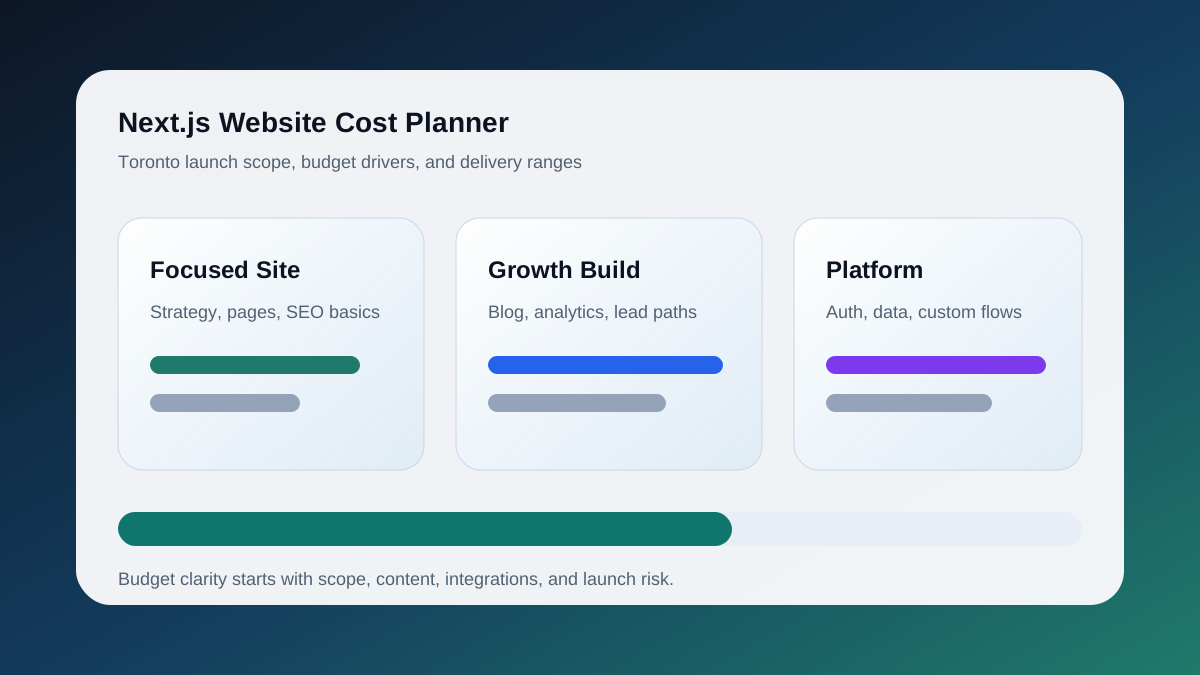
Cost to Build a Next.js Website in Toronto in 2026
A practical breakdown of what Toronto businesses should expect to pay for a Next.js website, what changes the price, and when the stack is worth it.

Next.js SEO Setup — The Complete Technical Guide
How to set up SEO properly in Next.js App Router. Covers metadata, sitemaps, robots.txt, structured data, Open Graph images, and canonical URLs.

Behind Céleste: Premium AI Aesthetic Previsualization MVP
A refreshed look at Céleste, a luxury AI aesthetic previsualization MVP, with desktop and mobile screenshots, privacy-aware UX, and conversion lessons.
Related services
Compare the next practical service path
Most projects cross design, engineering, search, and launch work. Use these adjacent services to compare scope before starting.
Service path
Web Design Toronto
Premium web design services for Toronto businesses — strategy-first, conversion-focused, and built to perform in local search.
Explore Web Design TorontoService path
Next.js Developer Toronto
Senior Next.js development for Toronto teams that need fast websites, App Router architecture, technical SEO, and reviewed Vercel deployments.
Explore Next.js Developer TorontoService path
Technical SEO Audit
Engineering-led technical SEO audits for Toronto websites with indexing issues, Search Console gaps, GA4 blind spots, thin schema, crawl waste, or slow pages.
Explore Technical SEO AuditPlan your custom web development project.
Share your current website, business goals, and delivery constraints. We will help define the scope, priorities, and next step for your project.