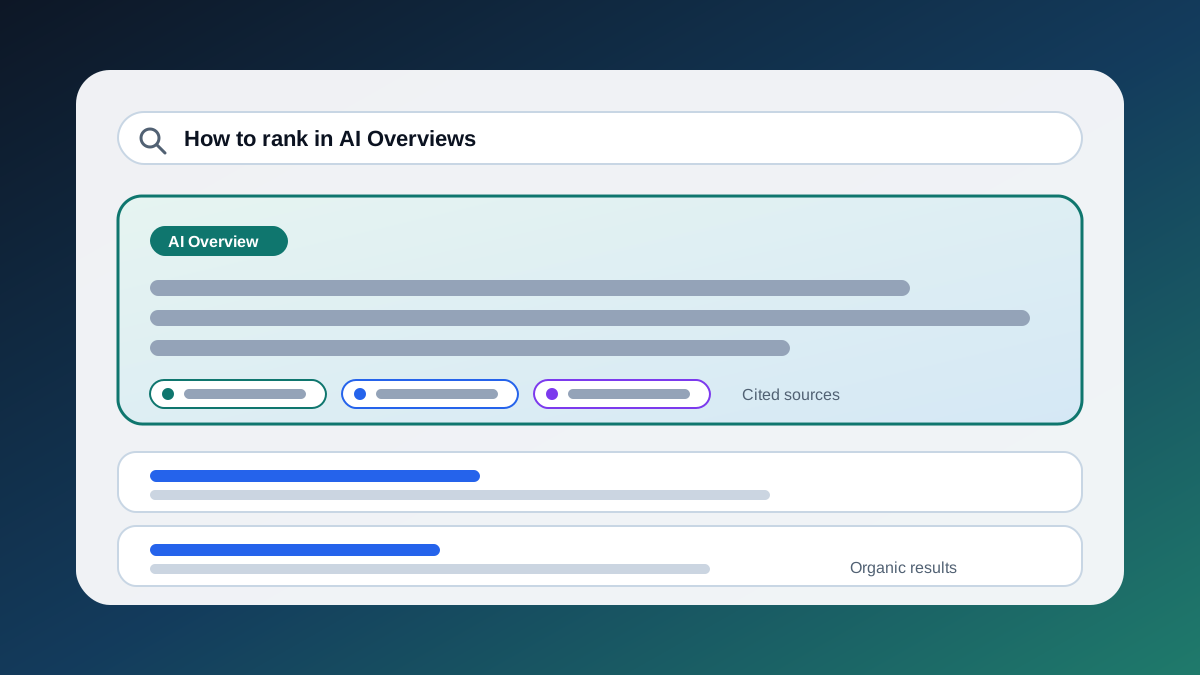
Ranking in Google AI Overviews means one of your pages is cited as a supporting link inside the generated answer at the top of a search result, or inside an AI Mode response. There is no separate index, no AI-specific ranking system, and no submission form. Google's documentation states that a page must be indexed and eligible to show a snippet, and that there are no additional requirements or special optimizations. In practice, inclusion is influenced by three things: whether Googlebot can crawl and render the page, whether the page ranks for the query or for the related sub-queries Google generates through query fan-out, and whether the page contains a passage that answers the question directly enough to be extracted. Entity clarity, freshness, and third-party corroboration help Google trust the source. Nothing guarantees a citation. This guide covers what we do for clients, what the published data supports, and what to skip.
How Do AI Overviews Choose Which Pages to Cite?
AI Overviews are grounded in Google's normal search index. The system runs the query plus related sub-queries, pulls candidate pages from those results, and extracts passages that answer the question. Pages that rank well are more likely to be candidates, but a growing share of citations now comes from outside the top ten.
Google's AI features documentation (last updated December 10, 2025) describes a "query fan-out" technique: while a response is generated, the models identify additional supporting pages so the answer can link to a wider set of sources. The same page states that a page must be indexed and snippet-eligible, and that no other requirements exist. AI Overviews and AI Mode may use different models, so their links for the same query can differ.
The ranking relationship is real but loosening. Ahrefs analyzed 863,000 keyword SERPs and 4 million AI Overview URLs in a March 2, 2026 study and found that 37.9% of cited URLs also appeared in the first ten result blocks, down from roughly 76% in its July 2025 analysis. Ahrefs attributes much of the change to fan-out: Google cites pages that rank for the sub-queries.
Two conclusions follow. Classic ranking work is still the shortest path, because a top-ten page is a candidate by default. And a page that answers a specific sub-question well can be cited without ranking for the broad query, which is why passage quality matters as much as authority.
What Do Search Console's AI Reports Tell You?
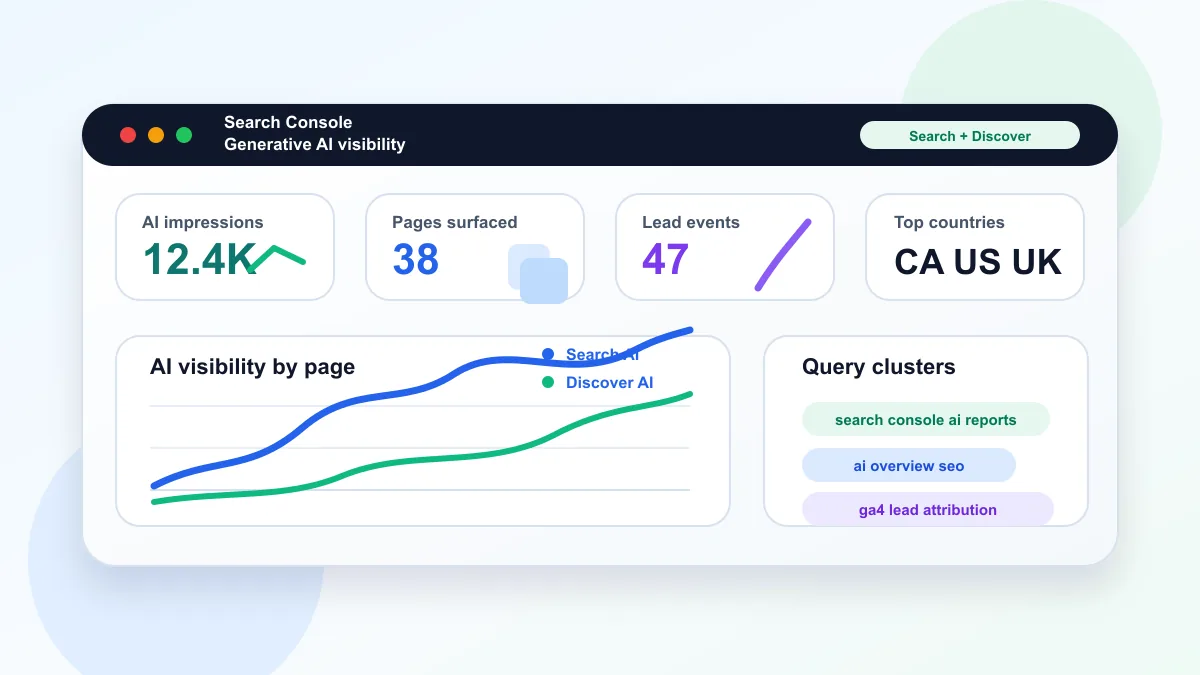
Search Console's generative AI performance report shows impressions from AI Overviews and AI Mode by page, country, device, and date. It confirms which URLs Google is already surfacing in AI features. It does not report AI-specific clicks or leads, so treat it as a visibility diagnostic, not a revenue report.
We covered the report in Search Console AI Reports: What Site Owners Should Track. The short version: before changing content, export the report, confirm the property's Search generative AI inclusion setting is on, and list the pages already receiving AI impressions. Those pages prove Google considers the site eligible to cite, and improving them is usually faster than starting from zero.
The report also shows gaps. If a page ranks in the top ten for a question-style query but shows no AI impressions, the likely cause is passage structure: no single block of text answers the question cleanly. That is a content fix, not a technical fix.
How Should You Structure Passages So They Can Be Extracted?
Write each section so a single paragraph can stand alone as the answer. Use a question as the heading, follow it with a direct answer of roughly 130 to 170 words, then add detail, dated facts, and a table where comparison helps. Google says chunking is unnecessary; clear self-contained answers are simply good writing.
Google's AI optimization guide (last updated July 10, 2026) says there is no requirement to break content into tiny pieces for AI systems. We still structure pages this way because it helps readers scan and lets any retrieval system find the answer without the surrounding sales copy.
The pattern we use across client sites:
| Element | What we do | Why it helps |
|---|---|---|
| Question headings | Phrase each H2 as the question a buyer would type | Matches how fan-out sub-queries are worded |
| Lead answer | Open each section with a complete, self-contained answer | Gives an extractable passage that survives without context |
| Dated facts | Attach a date and a source to every statistic | Lets Google and readers judge freshness and credibility |
| Comparison tables | Use a table when two or more options are compared | Tables are easy to summarize accurately |
| Named entities | Use full product, place, and organization names | Reduces ambiguity about what the page is about |
| Visible schema alignment | Keep Article, Organization, and BreadcrumbList data matching the visible page | Google asks that structured data reflect on-page content |
Do not bury the answer under an introduction that restates the question, and do not hedge so much that the passage is useless when quoted alone. If the honest answer is "it depends," say what it depends on in the same paragraph.
Which Entity and Brand Signals Matter?
Google needs to know who published the page and whether that publisher is credible. Consistent name, address, and phone details across the site and third-party listings, an Organization schema with sameAs links to real profiles, and genuine mentions on other sites all reduce ambiguity. Google warns that manufactured mentions do not help.
Entity signals are about consistency rather than volume. For a local service business, the legal name, address, and phone number should be identical on the site footer, the contact page, Google Business Profile, and the few directories that matter in your city. The Organization JSON-LD on the homepage should carry sameAs URLs pointing to profiles you control, not placeholder pages.
Third-party corroboration matters because AI Overviews increasingly answer commercial questions. Semrush's July 2, 2026 study of more than 600,000 U.S. keywords found that AI Overviews on commercial-intent queries grew 71% between November 2025 and April 2026. Commercial answers lean on reviews, case studies, and independent coverage, which are earned through real work. Google's optimization guide calls out inauthentic brand mentions as ineffective.
Which Crawlers Need Access, and What Does Google-Extended Control?
Googlebot is the only crawler that matters for AI Overviews. If Googlebot can fetch and render the page, and the page is indexed with snippets allowed, it is eligible. Google-Extended is a robots.txt token that controls Gemini model training and grounding in Gemini apps; blocking it does not affect Search or AI Overviews.
Google's crawler documentation (last updated July 14, 2026) states that Google-Extended does not have a separate user agent string, that crawling happens through existing Google user agents, and that the token "does not impact a site's inclusion in Google Search nor is it used as a ranking signal." So a robots.txt line disallowing Google-Extended is a policy decision about Gemini training, not an AI Overviews lever in either direction.
What does affect eligibility:
- A
noindexdirective removes the page from consideration entirely. nosnippetordata-nosnippetremoves the page or the marked section from AI features, because a snippet-ineligible page cannot be cited.max-snippetlimits how much text Google can show, and Google documents that it applies to AI features too.- Blocked JavaScript, CSS, or API routes that the page needs to render its main content can leave the extractable answer invisible to Googlebot.
Check the rendered HTML with the URL Inspection tool. On Next.js sites we confirm that answer paragraphs are server-rendered and that no client-only component holds the key text.
What Does Not Work for AI Overviews?
FAQ schema, HowTo schema, keyword stuffing, and an llms.txt file do nothing for Google AI Overviews. Google retired FAQ rich results, says no AI-specific files or markup are needed, and states that its systems understand synonyms without exact-match phrasing. Effort spent on these is effort taken from content and crawlability.
The list, with the reason for each:
- FAQPage schema. Google removed the FAQ rich result, and its AI documentation lists no schema type as an eligibility factor. Our own validation script rejects it.
- HowTo schema. Same situation: the rich result is deprecated and nothing indicates it feeds AI Overviews.
- llms.txt. The AI optimization guide says you do not need to create new machine-readable files or AI text files to appear in Google Search. We treat llms.txt as optional for other assistants and assume Google ignores it.
- Keyword repetition. Google says its AI systems can understand synonyms and general meaning. Repeating the exact query phrase adds nothing and makes passages read worse when quoted.
- Thin variant pages. Near-duplicate pages for every phrasing of a question risk the scaled content abuse policy and dilute the page that should be cited.
- Citation guarantees. No vendor, plugin, or tactic can promise inclusion. Google decides per query and per model.
How Do You Measure AI Overview Visibility?
Measure three layers: AI impressions by page in Search Console, organic clicks and positions for the same pages, and lead events in GA4 by landing page. Compare consistent date ranges and annotate Google updates. Expect lower click-through on informational queries even when you are cited, and judge success on qualified inquiries.
The published click data is worth stating plainly. Pew Research Center's July 22, 2025 analysis of 68,879 searches by 900 U.S. adults in March 2025 found that users clicked a traditional result in 8% of visits when an AI summary appeared, versus 15% when it did not, and clicked a link inside the summary itself in only 1% of visits. Ahrefs' April 17, 2025 study of 300,000 keywords estimated a 34.5% reduction in position-one click-through rate on informational queries where an AI Overview appears.
So the goal is not to be cited everywhere. It is to be cited on questions close to a purchase decision, where a click or brand recall is worth something. The loop we run:
- Pull AI impressions by page from Search Console for the last full reporting period.
- Cross-reference with organic clicks and average position for the same URLs.
- Pull GA4
generate_leadandform_startevents by landing page for the same period. - Flag pages with rising AI impressions and flat leads. Those need a stronger call to action, not more content.
- Flag pages ranking in the top ten for question queries with zero AI impressions. Those need passage structure work.
Do not add AI impressions to the standard performance totals; they are already included. And do not attribute a lead to an AI Overview because both rose in the same week.
What Would This Look Like for a Toronto Small Business?
Consider a hypothetical Toronto HVAC company whose service pages rank for "furnace repair Toronto" but never appear in AI Overviews for questions like "how often should a furnace be serviced." The fix is a question-led guide with direct answers, consistent business details, and links from the guide to the service page. Results would be judged on inquiries.
The scenario, with no invented numbers:
The company checks Search Console's AI report and finds a few impressions on its blog but none on service pages. A crawl shows the service pages render their main copy through a client-side script, so Googlebot sees headings and a booking widget but little text. That is the first fix: the copy moves into server-rendered markup.
Next, the team writes one guide titled with the question customers actually ask. Each H2 is a question, each section opens with a self-contained answer, and a table compares service intervals by furnace type. Maintenance claims cite the manufacturer or a dated source. The guide links to the service page and the contact page.
Then the team aligns entity signals: name, address, and phone match Google Business Profile exactly, the Organization schema gains sameAs links to real profiles, and a few genuine local mentions come from existing supplier partnerships.
After a few crawl cycles, the team reviews the AI report and GA4 together. If the guide earns AI impressions and service-page form starts rise over a consistent window, the loop worked. If impressions rise and inquiries do not, the call to action and offer are next to test.
This is the sequence behind our AI SEO Content Systems service: fix crawlability and rendering, restructure the pages that already have intent, then measure with Search Console and GA4 rather than a vendor's AI visibility score. If you want a second set of eyes on a site, start a project and we begin with the audit.
Keep the Thread Going
- Service path: AI SEO Content Systems
- Technical audit path: Technical SEO Audit Toronto
- Related guide: Search Console AI Reports
- Ready to fix the search foundation? Start a project