Getting indexed is not the same as ranking.
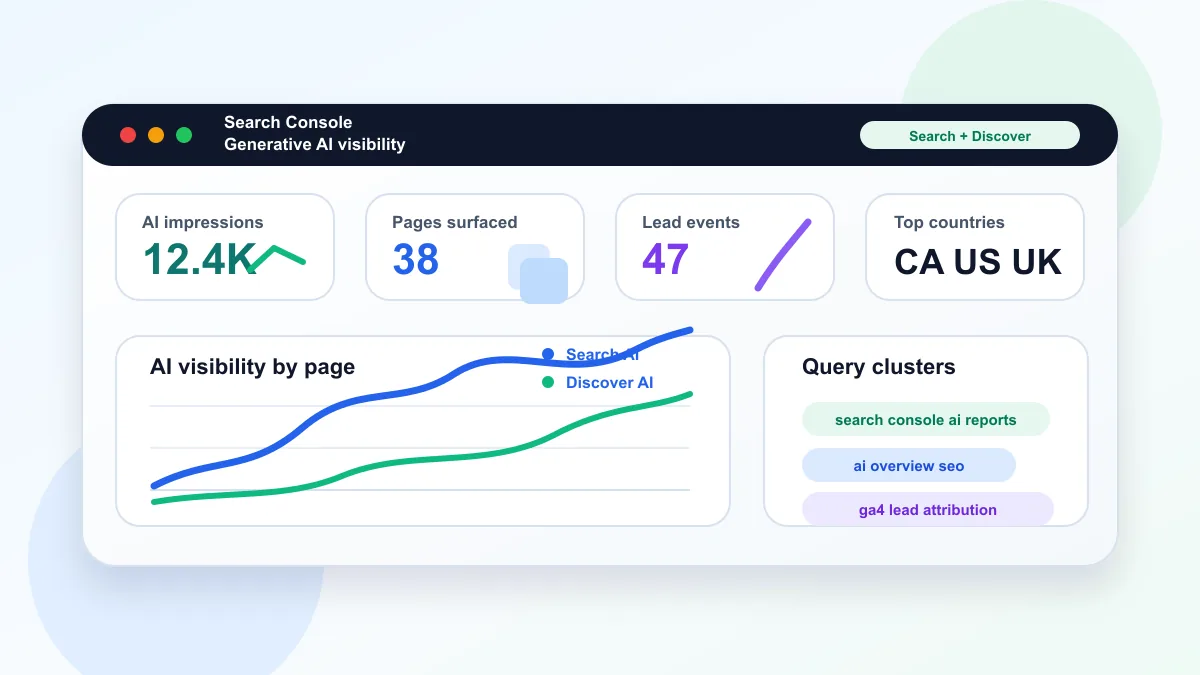
Search Console can show that Google has discovered your pages, crawled some of them, and even started showing impressions. But if the pages are ranking on page eight for weak keywords, the site still has a visibility problem.
This usually means Google can find the site, but it does not yet have enough confidence in the page quality, topical structure, internal links, or entity signals to rank it for better commercial terms.
When a page is indexed but weak, do not start by rewriting everything. Start with the queries and pages already visible in Search Console, then improve intent match, internal links, visible proof, and crawl signals on the pages closest to commercial value.
1. The Page Targets the Wrong Intent
Many service pages accidentally target the company instead of the buyer.
Weak page:
- "We build modern websites"
- generic capabilities
- no local proof
- no pricing context
- no FAQs
- no comparison or decision help
Stronger page:
- "Web Design Mississauga"
- clear buyer problem
- local service context
- process and deliverables
- proof and examples
- Search Console-informed FAQs
If the page does not match a real search intent, indexing will not matter much.
2. Internal Links Are Too Weak
Google discovers and evaluates pages through links. A new service page should not only exist in the sitemap. It should be linked from:
- services index
- the homepage
- related service pages
- relevant blog posts
- related tutorials
- footer or hub sections where appropriate
If a page matters commercially, it should not be three clicks away with only one generic link.
3. The Page Is Too Thin
Thin pages can get indexed, but they rarely rank for competitive terms.
A strong service page usually needs:
- a clear H1
- useful intro copy
- buyer-specific deliverables
- process
- pricing or range context
- proof
- FAQs
- internal links
- structured data
This is why a real Technical SEO Audit Toronto looks at content depth and crawl paths together.
4. Schema Is Missing or Misused
Schema does not magically rank a bad page. It helps Google understand the page when the content already deserves understanding.
Useful schema types for a service business:
- BreadcrumbList
- Service
- LocalBusiness
- Organization
- Article or BlogPosting
- SoftwareApplication for tools
- VideoObject when the page has real video
Be careful with FAQ and review markup. FAQ rich results no longer appear in Google Search as of May 7, 2026, so keep FAQs visible for users without adding FAQPage schema; review markup should only be used where the review type is eligible, visible on the page, policy-compliant, and not self-serving.
5. Search Console Is Telling You the Next Page to Build
Open Search Console and look for:
- impressions with no clicks
- page eight to ten rankings
- queries where the current page is a poor match
- city modifiers
- platform modifiers
- "cost", "vs", "audit", and "developer" modifiers
Those are often the next content or service pages to build.
Use a simple diagnostic order before writing anything new:
- Check Page indexing for whether Google selected the same canonical you expected.
- Use URL Inspection to confirm Google can crawl the live version.
- Compare the visible page against the queries getting impressions.
- Review whether related service, blog, tutorial, and work pages link to it.
- Check whether the page has enough proof, pricing context, and decision help for the query.
- Update the page, then request recrawl for the most important URLs and monitor the query-page pair.
For example:
- "nextjs developer toronto" maps to Next.js Developer Toronto
- "woocommerce developer toronto" maps to WooCommerce Developer Toronto
- "seo services toronto" maps to SEO Services Toronto
- "technical seo audit toronto" maps to Technical SEO Audit Toronto
- "shopify agency toronto" maps to Shopify Development Toronto
- "web3 development agency" maps to Web3 Development Services
6. The Site Has No Clear Commercial Cluster
Google understands clusters better than isolated pages.
For ValeoFX-style service businesses, a stronger cluster looks like:
- core services page
- individual service pages
- city-specific service pages
- problem articles
- comparison articles
- technical guides
- proof/case-study pages
Each page supports the others with natural links.
Keep the Thread Going
- Service path: Technical SEO Audit Toronto
- Related service: SEO Services Toronto
- Comparison path: SEO Services Toronto
- High-intent page: Shopify Development Toronto
- Emerging demand page: Web3 Development Services
- Related guide: Next.js SEO Setup
- Ready to audit your indexing path? Start a project
- SEO budget guide: How Much Does SEO Cost in Toronto?
- Local vs technical: Local SEO vs Technical SEO for Toronto Businesses