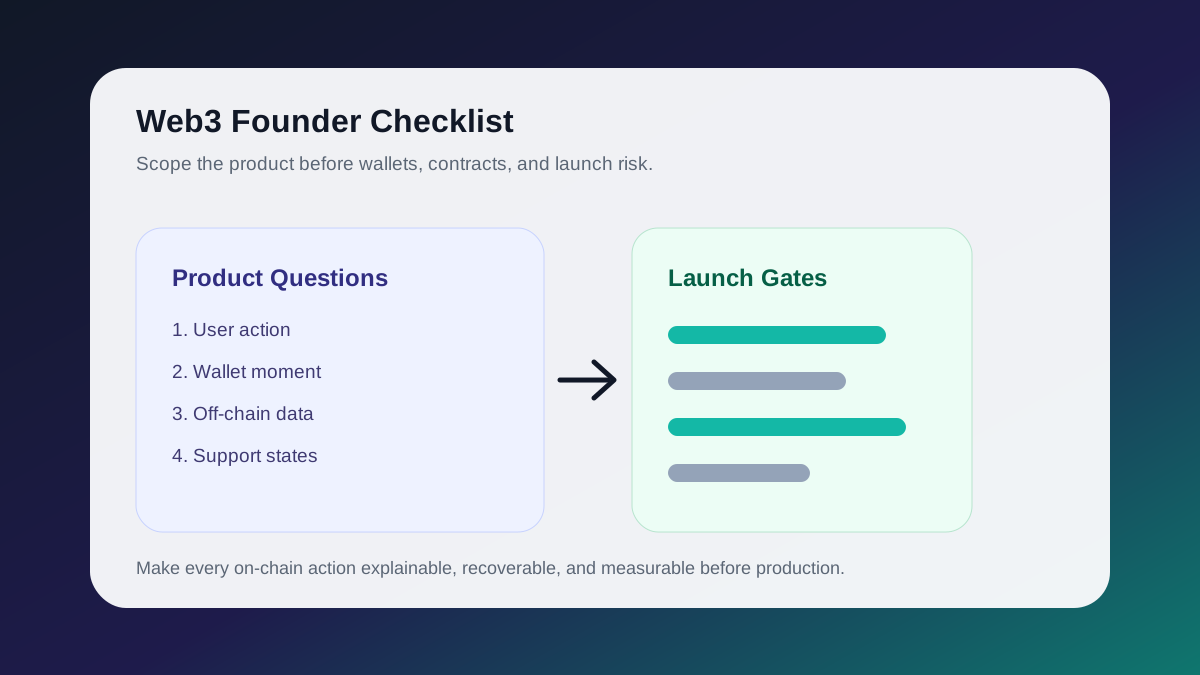
Web3 app development fails when teams treat the blockchain piece as the product. The better approach is to start with the user action, then decide where wallets, contracts, tokens, and on-chain records actually improve the experience.
This checklist is for founders preparing a Web3 MVP or production build. It helps you scope the product before engineering starts.
For implementation support, see Web3 Development Services.
The launch advice here is intentionally conservative. Founders should scope the first release around one wallet flow, one core transaction, clear failure states, analytics, and a security review that matches the financial or reputation risk.
1. Define the User Action
Start with the one action the user must complete.
Examples:
- mint an item
- connect a wallet
- claim access
- verify ownership
- sign a transaction
- purchase a tokenized asset
- view a portfolio
- redeem a membership benefit
If you cannot explain the core action in one sentence, the product is not ready for a build sprint.
2. Choose the Chain With Product Constraints in Mind
Chain choice affects cost, speed, wallet support, liquidity, tooling, and user trust.
Before choosing, answer:
- Where are your users already active?
- What wallet support do they expect?
- What transaction cost can the product tolerate?
- Do you need EVM compatibility?
- Is the chain supported by your analytics and infrastructure tools?
- What happens if transaction confirmation is slow?
The right chain is not always the most popular one. It is the one that fits the user journey and operating model.
3. Map Wallet and Account Flows
Wallet UX is where many Web3 products lose normal users.
Plan for:
- wallet connect states
- account switching
- disconnected users
- unsupported networks
- failed signatures
- rejected transactions
- mobile wallet handoff
- users with no wallet
- hybrid login if you support email first
Every error state needs a human-readable explanation. "Transaction failed" is not enough.
Founders should also decide the account strategy before design starts:
- traditional wallet-first connection
- email-first or embedded wallet onboarding
- passkey support for returning users
- gas sponsorship or user-paid fees
- account recovery expectations
- unsupported network handling
- mobile wallet handoff behavior
- fallback path when a wallet provider is unavailable
Those choices change the product, not just the integration. A crypto-native dashboard and a mainstream membership product may need completely different wallet defaults.
4. Separate On-Chain and Off-Chain Data
Not everything belongs on-chain.
Use on-chain data for:
- ownership
- transfer history
- contract-enforced rights
- token identity
- public state that needs trust
Use off-chain data for:
- editable profiles
- analytics
- support notes
- drafts
- private user preferences
- expensive or frequently changing data
A clean Web3 architecture usually combines both. The contract should not become a database for everything.
5. Scope Smart Contract Responsibilities
Before writing contracts, decide what the contract owns.
Checklist:
- token standard
- minting rules
- admin permissions
- upgrade strategy
- pause or emergency controls
- allowlist or access control
- metadata strategy
- royalties or fees
- audit requirements
If a mistake would create financial, legal, or reputation risk, budget for deeper review before launch.
Security gates should match the risk of the launch:
- internal review for prototypes with no customer funds
- testnet rehearsal for every user-facing transaction
- external audit or specialist review for contracts that hold value
- multisig controls for admin actions
- documented upgrade, pause, and emergency procedures
- monitoring for failed transactions and suspicious activity
- incident response owner before launch day
Do not treat the contract as finished when it compiles. Treat it as finished when the team knows how it behaves, who can change it, and what happens when something goes wrong.
6. Design for Trust
Users need to understand what they are signing.
Strong Web3 UX includes:
- plain-language transaction summaries
- visible network and wallet state
- fee expectations
- confirmation states
- failure recovery
- support links
- clear ownership language
- security notes when actions are irreversible
Trust is a design requirement, not a paragraph in the footer.
7. Add Analytics Before Launch
Measure the product journey before you announce it.
Track:
- wallet connect attempts
- successful connects
- signature attempts
- rejected signatures
- transaction starts
- transaction failures
- completed on-chain actions
- returning users
- support clicks
Without analytics, you will not know whether users are confused, blocked, or simply uninterested.
8. Launch With a Smaller Surface
Most Web3 MVPs should launch with fewer features than the founder wants.
A strong MVP has:
- one core wallet flow
- one core transaction
- clear fallback states
- analytics
- support path
- security review appropriate to risk
- a roadmap for iteration
Do not launch five smart-contract interactions when one has not been validated.
Keep the Thread Going
- Service path: Web3 Development Services
- Case study: MintoCrypto Case Study
- App path: App Development Toronto
- Ready to scope a launch-safe Web3 MVP? Start a project