
Most Toronto small businesses we work with have the same problem: they rank fine on a broad search but disappear the moment someone types "near me" or adds a neighbourhood name. Local SEO is a distinct discipline from general SEO, and it has its own checklist. This guide covers everything you need to set up local search properly — from your Google Business Profile through to schema markup and review generation.
Google Business Profile Optimisation
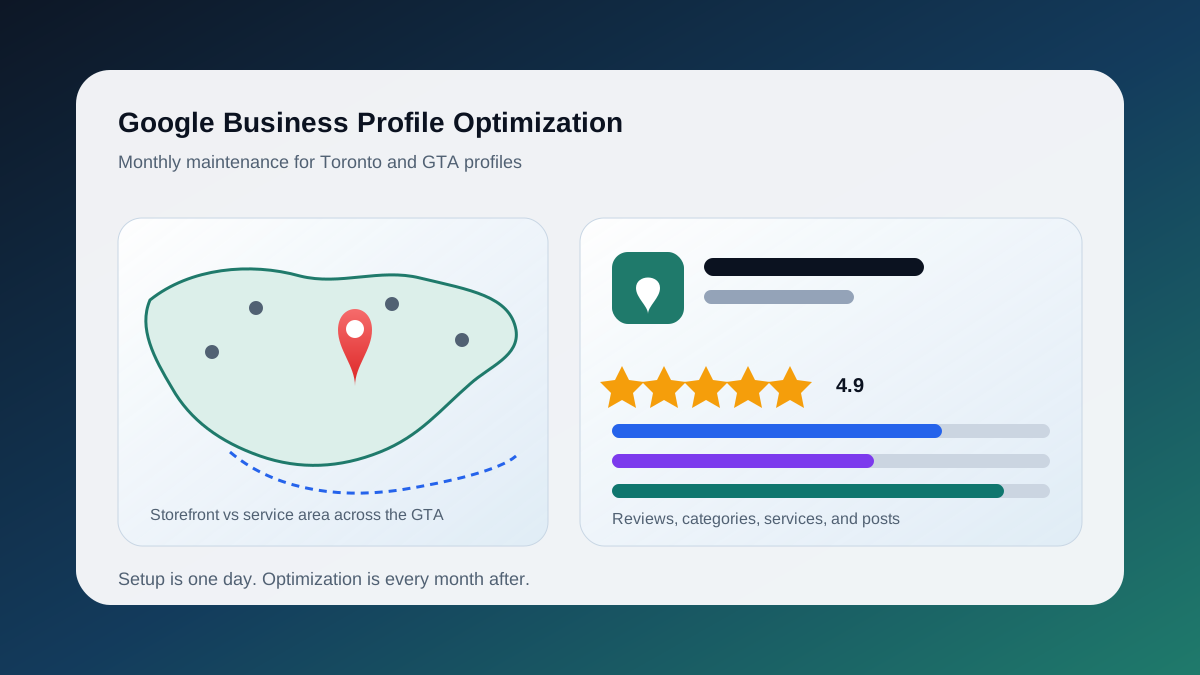
Your Google Business Profile (GBP) is the single highest-leverage asset in local SEO. Get it wrong and nothing else matters much.
Primary category is the most important field. Pick the one that most precisely describes your core offering — "Web Design Company" or "Marketing Agency" rather than a generic catch-all. You can add secondary categories afterward, but Google weights the primary heavily for map pack eligibility.
Attributes vary by category but fill in everything that applies: women-led business, online appointments, accessibility features. These surface in Google Maps and help you appear in filtered searches.
Photos and videos help customers understand the business and complete the profile. Add a logo, cover photo, interior/exterior photos, product or service photos, and team images, following Google's photo and video guidance. Treat freshness as customer-experience maintenance, not a guaranteed ranking lever.
Google Posts are useful for current offers, events, announcements, and service updates. Use them to keep the profile helpful for searchers, then verify visibility in the live GBP dashboard rather than relying on a fixed seven-day SEO rule. See Google's Business Profile posts guidance.
Service areas should match where the business actually serves customers. Google currently allows up to 20 service areas and recommends being specific and accurate, with the overall area close to the business base.
NAP Consistency Across the Web
NAP stands for Name, Address, Phone. Keep the canonical NAP consistent across your site, GBP, and priority citations because inconsistent public business information makes verification and customer trust harder.
Audit your NAP before building any new citations:
- Decide on a canonical version of your name, address, and phone number.
- Run your business name through Google to find every existing mention.
- Update or claim any listings where the details differ.
In Toronto, common sources of stale data include Canada411, Yelp, YellowPages Canada, and older chamber of commerce directories. Fix these first because data aggregators pull from them.
Local Citation Building
Citations are any online mention of your NAP. You do not need hundreds — you need the right ones, consistent and complete.
Priority citations for Toronto businesses:
- Google Business Profile — already covered above, but it is itself a citation source.
- Yelp Canada — high domain authority, frequently scraped by aggregators.
- Yellow Pages Canada (yp.ca) — one of the most influential Canadian directories.
- BBB (Better Business Bureau) — useful for some service categories when customers expect third-party credibility signals.
- 411.ca — a major Canadian data aggregator; getting this right cascades across smaller directories.
- Toronto Board of Trade or your local chamber (Mississauga Board of Trade, Brampton Board of Trade, etc.) — local relevance signals matter.
- Houzz (for trades, home services, and design firms), Clutch (for agencies and tech services), Justdial — pick the vertical directories relevant to your industry.
When building citations, use the exact same NAP string everywhere. Do not abbreviate your business name in one place and spell it out in another.
LocalBusiness Schema Markup
Structured data tells Google explicitly what your business is, where it is, and what it does. Implement it as JSON-LD in the document head of your homepage and service-area pages where relevant.
For a Toronto-based service business, include the fields Google needs to understand the entity clearly:
- business name, URL, logo, and representative image
- concise service description
- public phone number and contact email if you list them on the page
- postal address or service-area configuration that matches your Google Business Profile
- cities served across the GTA, such as Toronto, Mississauga, Brampton, Scarborough, North York, and Markham
- opening hours and price range where applicable
- official social profiles that match the brand
Validate the JSON-LD with Google's Rich Results Test before deploying. The service-area fields are particularly important because they tell Google which GTA cities you actively serve without forcing you to publish a storefront address that does not exist.
Location-Specific Content Strategy
A single homepage is not enough to rank across the GTA. Google's local algorithm rewards geographic relevance, and that means having content that directly matches the searcher's location.
Service-area pages are the core tactic. Create a dedicated page for each major market you serve, such as Mississauga web design, North York SEO, or Scarborough web design. Each page should include:
- A title and H1 that names the city and service explicitly.
- Two or three paragraphs describing how your service applies in that specific area — reference local landmarks, business districts (Yonge and Eglinton, Scarborough Town Centre, downtown Brampton), or the kinds of businesses you typically work with there.
- A locally-relevant testimonial or case study if you have one.
- Your NAP for that location (or your main NAP with the service area noted).
- LocalBusiness schema with the served area scoped to that city.
Neighbourhood targeting goes one level deeper. For Toronto proper, neighbourhoods like Liberty Village, The Annex, Leslieville, Danforth Village, and Yonge-Sheppard each have distinct business communities. If you serve clients in specific neighbourhoods, mention them naturally in your content and in your GBP description.
Avoid spinning boilerplate across pages — Google detects thin, templated location pages and they offer little ranking benefit. Write each page as if it is the only piece of content for that market.
Review Strategy
Reviews are an important local trust signal and can influence map pack visibility. Volume, recency, rating quality, owner responses, relevance, and proximity all matter, so do not reduce local SEO to one review-count target.
Ethical review generation:
- Ask at the right moment. The best time to request a review is immediately after a positive interaction — project delivery, successful support call, or in-person service completion. Satisfaction is highest then.
- Make it effortless. Create a short Google review link (via your GBP dashboard under "Get more reviews") and send it directly. Every extra click you add reduces completion rates.
- Follow up once. A single reminder email or text a week later is acceptable and often improves completion from asks to reviews.
- Respond to every review. Google pays attention to owner responses. Reply to positive reviews briefly and professionally; reply to negative ones within 24 hours with a calm, solution-oriented message. Never argue publicly.
Do not offer incentives, purchase reviews, or ask employees to review your business. Google's systems detect these patterns and the consequences — review removal, GBP suspension — are severe and difficult to recover from.
Tracking Local Rankings
You cannot manage what you do not measure. Local rankings behave differently from national organic rankings because they are tied to the searcher's physical location.
Google Search Console shows you which queries are driving impressions and clicks to your site. Filter by your target city names to understand your baseline. It will not show map pack data, but it is essential for tracking organic local landing page performance.
Local rank trackers: tools like BrightLocal, Whitespark Local Rank Tracker, and Local Falcon let you track map pack rankings from a specific postal code — useful for seeing how you rank in different parts of the GTA (e.g. how you appear to someone searching in Etobicoke vs. downtown Toronto vs. Scarborough).
GBP Insights gives you direction/maps searches, website clicks, calls, and photo views directly inside your Google Business Profile dashboard. Check it monthly and look for trends rather than individual data points.
Set a simple monthly tracking routine: log your map pack position for your five most important keywords from your primary service area, note your GBP call and direction volumes, and review any new citations or reviews acquired. Consistency over three to six months gives you enough data to make informed decisions.
Local SEO for Toronto businesses is not a one-time setup — it compounds over time as you accumulate citations, reviews, and locally-relevant content. The businesses we see rank consistently in the map pack are the ones that treat it as an ongoing channel, not a project to complete.
For more context on local and technical prioritization, read Local SEO vs Technical SEO for Toronto Businesses. For budgeting, use How Much Does SEO Cost in Toronto?. You can also explore the EuroMotors case study to see local SEO results in action.
If you would rather have an expert handle this, we offer local SEO services for Toronto businesses covering everything from GBP management to schema implementation and citation audits. Use the comparison section on that page to compare delivery models, or start a project to request an assessment.
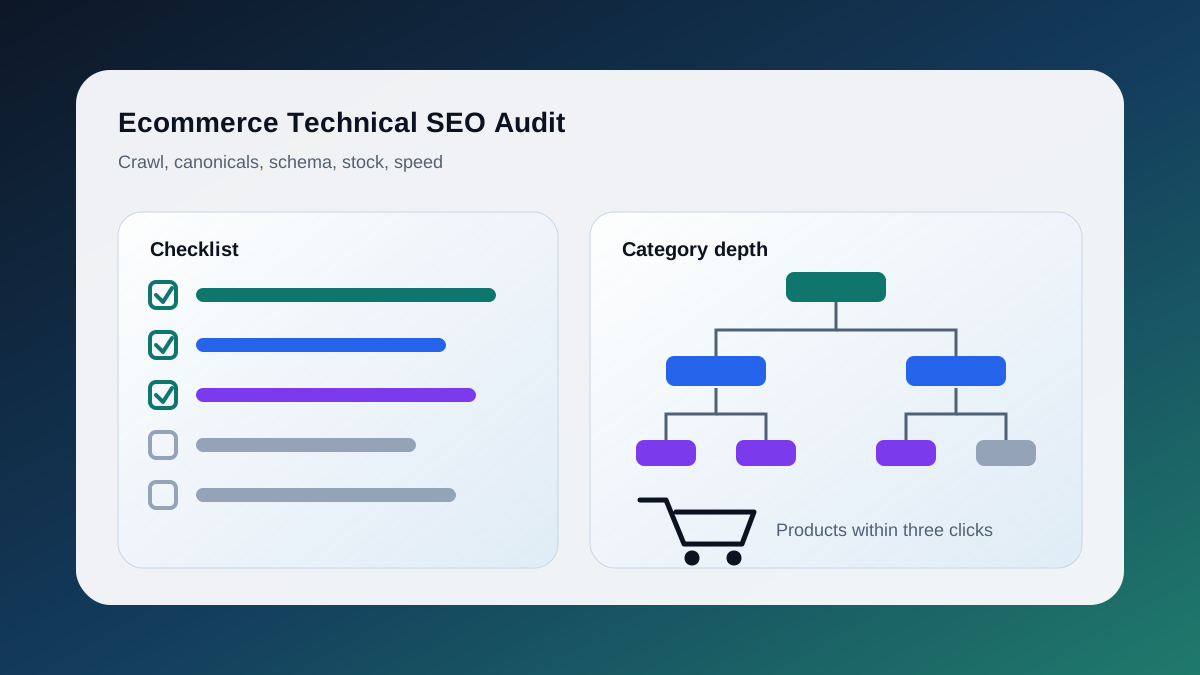
If your local search demand is ecommerce-specific, pair the SEO setup with a focused Shopify Development Toronto landing page so product, checkout, and local intent signals reinforce each other.